


Amex Family
If you have received a signup bonus from a higher tiered card, you are ineligible to receive a bonus from a lower tiered card in that same card family
Deep Dive into the Amex Family Rule
You have to get certain American Express cards in a specific order to maximize your chances of earning signup bonuses on all cards within that family. This rule becomes even more important because of Amex's 1/7 Rule, which may prevent you from earning another signup bonus on the same card for many years. If you aren't aware of the American Express Family Rule, you could miss out on a big signup bonus simply by applying for certain Amex cards in the wrong order.
American Express has several families of non-co-branded cards where this type of restriction can apply:
Membership Rewards Cards
The American Express Green Card is no longer available to new applicants, but it remains relevant to this rule for anyone who has held it in the past. For cards that are currently available, the most important sequencing decision is generally to get the Gold before the Platinum if you want the opportunity to earn both signup bonuses.
Cash Back Cards
For these two cards, the general strategy is to get the Blue Cash Everyday before the Blue Cash Preferred if you want the opportunity to earn the signup bonus on both.
American Express also uses similar family restrictions on some co-branded cards. We track the Delta Family Rule separately, and Marriott has its own set of eligibility rules because those restrictions are considerably more complicated.
What does this mean?
Within each family, the safest strategy is generally to work from the lower-tier card to the higher-tier card if you want to maximize your signup bonus opportunities.
For example, the American Express Gold Card has historically included language stating that you may not be eligible for its welcome offer if you have previously had the Gold Card, an earlier version of the Gold Card, or a Platinum Card. That means getting the Platinum first can eliminate your opportunity to earn the Gold signup bonus later. Here is what that family language looks like on a current Gold Card offer:
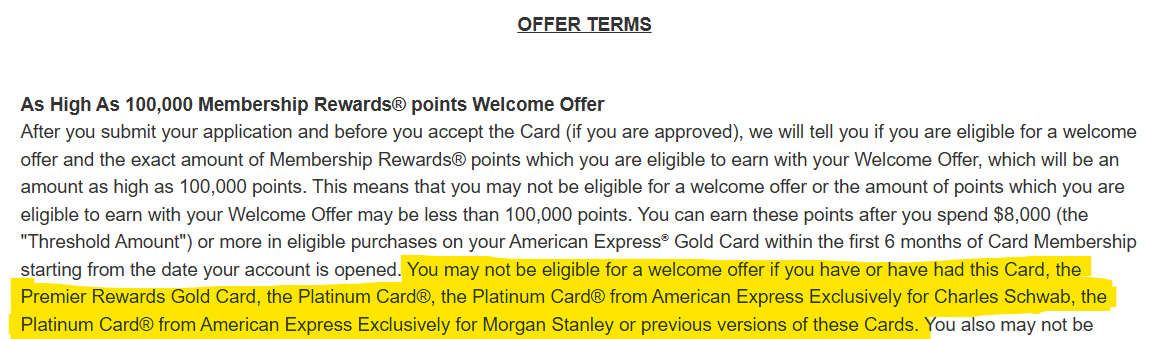
The Platinum restriction also includes the Charles Schwab and Morgan Stanley versions of the Platinum Card. Those cards require additional relationships to apply and are not a focus of our card rankings, but previously having one can still affect your eligibility for a lower-tier Membership Rewards card when the applicable family language is included in the offer.
Fortunately, there is generally no crossover between separate card families. Having a higher-tier Membership Rewards card, for example, does not by itself affect your eligibility for a Blue Cash welcome offer.
Check the terms of your specific offer
As you can see in the screenshot above, American Express has increasingly moved toward personalized and "as high as" welcome offers. Along with seeing different signup bonus amounts, whether it's "as high as" language or a set offer, he eligibility language can also vary between offers for the same card. One offer may include the Family Rule and lifetime language while another may not.
Here is what an offer looks like when that language is not included:
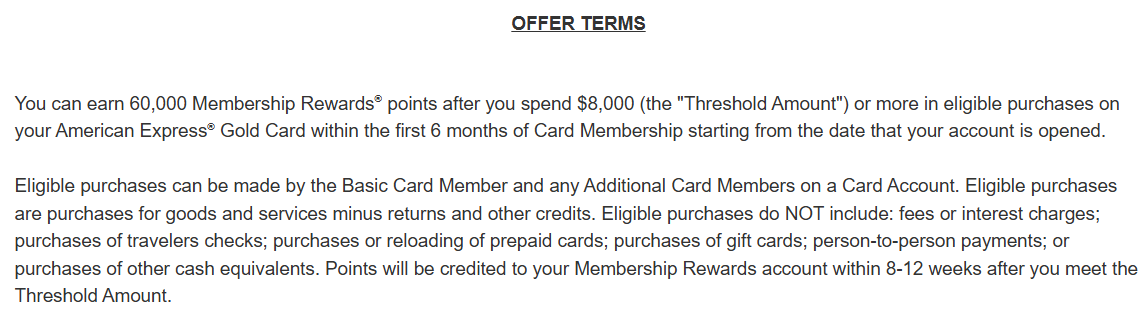
Because of that, always check the terms of the specific offer you're applying through rather than assuming the standard family restriction applies. If the offer does not contain language restricting you based on higher-tier cards you've previously held, you may still be eligible for the welcome bonus under that specific offer.
We cover these personalized offers and No Lifetime Language offers in more detail in our Amex 1/7 Rule.
Related Rules
How Does This Affect Your Credit Card Strategy?
Once you know and understand this rule, you simply have to apply for these cards in order. It’s a pretty simple rule to understand and implement. When it comes to card strategy, most people start with Chase cards as they have the most valuable rewards currency. Many in the hobby get their first American Express card after they’ve already gotten several Chase cards and maybe even a Capital One and/or Citi card.
If you have been denied a Chase card or want to diversify your points game to give yourself the best chance of not getting denied for a card, then getting into American Express Member Rewards is a good idea. But you need to have a strategy to best maximize your points and make sure you don’t miss out on a signup bonus for a specific card.
Important to know:
When it comes to American Express, we typically recommend starting with one of the Membership Rewards cards unless you are extremely loyal to Delta, Hilton, or Marriott. Below are the categories of ALL American Express cards on offer, and why we suggest starting with Membership Rewards.
The first three have the Family Rule while the last three do not.
- Membership Rewards: These cards are most flexible as the points can be transferred to any of American Express’ airline or hotel partners.
- Delta: Only offers points to be used with Delta - these offer value for those loyal to Delta or will be flying Delta for a trip in the upcoming year.
- Cash Rewards Only: The two cash cards that are part of this rule are low on our rankings of cards because they only offer cash back in the form of statement credits and can’t be transferred to a partner.
- Hilton co-branded cards: Hilton has its own set of co-branded cards from American Express as well, but as of now, they don’t have the same family rules as the Delta or Membership Rewards cards
- Marriott co-branded cards: Marriott also has co-branded cards - 3 offered by Amex (including a business card) and 3 offered by Chase. Marriott has its own set of rules regarding these cards and the bonuses you can earn, and because of the complicated nature of these rules, we have a completely separate rule page breaking those down.
- Business cards: American Express has business cards of the same exact names as the Membership Rewards cards - Green, Gold, and Platinum. You can get those in any order, though, and still be eligible for the signup bonus on each. Delta also has two business cards, and they are exempt from this rule as well.
Knowing all this, logic might dictate that you begin with the American Express Green card. But it’s not always that simple in the points and miles world. There is nuance to everything, and there are also other rules at play that you have to consider.
The regular signup bonus for the American Express Green card is 40,000 points, which isn’t nothing but it’s also not very high. It has a $150 fee attached to it (but it does also offer a $199 Clear Plus Membership credit that essentially cancels out that fee if it’s a credit you can use). Some people don’t think a card with a 40k point welcome offer is worth the spot on your 5/24, so they just skip to the American Express Gold card and start there. Some find it plenty valuable, and knowing that they won’t be able to get the bonus on the Green card if they get the Gold or Platinum, they logically start with Green. A lot depends on your 5/24 status as well, so many people in the hobby don’t want to “waste” a 5/24 spot on a card with a low signup bonus that still has an annual fee. As always, it all depends on your specific situation.
Importance of this Rule
* * * *
Like the American Express 1/10 Rule, this is an important rule to know and be aware of, but the Chase 5/24 rule is really the only rule that will impact nearly every card you apply for. You will miss out on a bevy of bonus points if you don’t know this rule and apply for the American Express Platinum card before any of the other ones. Fortunately, if you sign up and load all your cards into the Points Navigator, we’ll warn you of this and all the other complicated credit card rules so this doesn’t ever happen to you.
Cards Subject to This Rule






FAQs
Are there exceptions to this rule?
Yes, there are Membership Rewards business cards that mirror the personal ones. There are Green, Gold, and Platinum Business cards, but these don’t have the same set of rules. Same with cash cards - there is also a Blue Business Cash And Blue Business Plus card that also doesn't abide by these rules. Delta has several business cards as well - the Delta SkyMiles Gold, Platinum, and Reserve. You can apply for any of these cards in any order and still be eligible for the signup bonus on each. And because all of the above are all business cards, they also don’t count against your 5/24.
How do I check my status?
Once you are in the hobby for a while, you need to be organized with your cards and know which ones you’ve gotten and when. There are a lot of rules you have to be aware of, so organization is key. That’s the reason we built the Points Navigator. You can load all your cards into our system, and we’ll keep track of all the rules for you and alert you of any that you have tripped or are about to trip.
Do business cards count for this rule?
They do not. See “Are there exceptions to this rule?” above for a more detailed answer.
Do product changes on existing cards count for this rule?
Kind of. If you have an American Express Gold card and you don’t want to pay the $350 annual fee anymore, you could downgrade to the American Express Green card, which has a lower, $150 annual fee. When you downgrade a card, you aren’t generally eligible for a signup bonus anyway. Even if you were, you would not be eligible for the welcome offer because of this family rule. In the above scenario, you wouldn’t be eligible for the welcome offer on Green card anyway because of already having the Gold. This point is kind of moot, though, because of one of American Express’ other rules, the 1/10 rule. This rule says that you are only eligible for a signup bonus on an Amex card once every ten years, and because of this, we rarely recommend downgrading or product changing an Amex card since you generally can’t get a signup bonus on a product change.
About Approval Rules
Collecting credit card points is largely driven by understanding and abiding by bank rules regarding approval (or disapproval) of cards. So here's what you need to know:
- Approval rules are rarely fully publicized by the banks
- We use our own research and data points from other users in creating the rules listing
- Our goal in sharing/using the rule listings is to provide you guidance to avoid getting declined
- There can sometimes be exceptions to the rules, but we try to take a more cautious approach in advising you.