


Sapphire Lifetime
You may be ineligible for the signup bonus on a Chase Sapphire card if you previously earned a signup bonus on that same card.
Deep Dive into the Sapphire Lifetime Rule
Chase's lifetime-style signup bonus restriction applies separately to the Chase Sapphire Preferred, Chase Sapphire Reserve, and Chase Sapphire Reserve Business.
What does this mean?
- You can hold both the Chase Sapphire Preferred and Chase Sapphire Reserve at the same time. You can also hold the Chase Sapphire Reserve Business.
- Earning the signup bonus on one Sapphire card does not prevent you from earning the bonus on another Sapphire card.
- However, Chase's terms say the signup bonus may not be available if you previously held that same card or previously received its signup bonus.
Keeping up with the changes
Previously, the two personal Sapphire cards had a 48-month restriction on welcome offers along with a family restriction. You could only earn a bonus on one personal Sapphire card every 48 months, and you could not hold both cards at the same time.
That changed with the Sapphire Reserve relaunch in June 2025 and the introduction of the Chase Sapphire Reserve Business. Chase removed the 48-month language and added lifetime-style restrictions to all three cards. The initial terms for the personal Sapphire cards were vague, however, and enforcement was inconsistent.
Chase provided more clarity in January 2026. Under the current rules, eligibility is generally tied to the specific Sapphire card rather than the Sapphire family as a whole. If you previously earned the Sapphire Preferred bonus, for example, that does not by itself prevent you from earning the Sapphire Reserve bonus, and vice versa.
You can also hold both personal Sapphire cards at the same time, so there is no need to product change one before applying for the other. The Chase Sapphire Reserve Business is treated separately as well, so having that card does not affect your eligibility for either personal Sapphire card.
Here are the terms currently shown for the Sapphire Reserve and Sapphire Preferred:

How does this compare to Amex's lifetime rule?
Chase's lifetime-style restriction has been much stricter in practice than American Express's. Since the rule went into effect, there have been occasional data points of cardholders becoming eligible for a second bonus on the same Sapphire card, but they have not been common. The overwhelming majority of data points we have seen show cardholders remaining ineligible, even when many years have passed since they last earned the bonus.
That is a significant difference from Amex's lifetime rule, where second bonuses after roughly seven years are common enough that "lifetime" has historically functioned more like an unofficial waiting period. Chase's rule is much newer, so we still do not know whether that will change as more time passes.
Chase Sapphire Popup
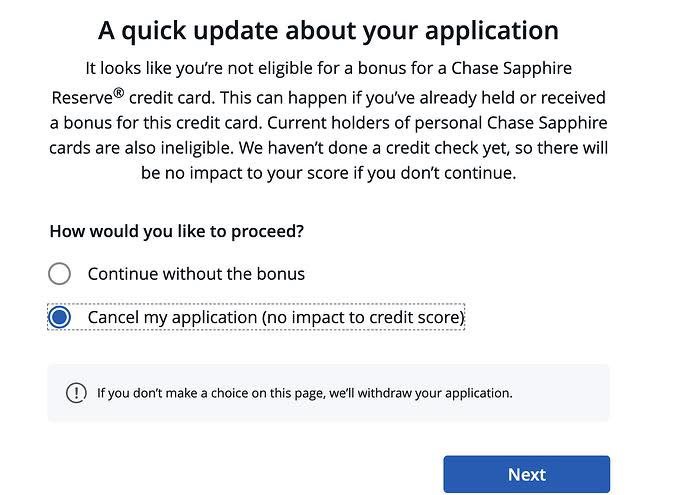
Fortunately, Chase also checks your bonus eligibility during the application process. If you are not eligible, a popup appears before Chase performs a hard credit check.
You can cancel the application at that point with no impact to your credit score, or continue with the application knowing that you will not receive the signup bonus. This makes it possible to test your eligibility without risking a hard pull if it has been a long time since you last held or earned a bonus on the card.
Related Rules
How Does This Affect Your Credit Card Strategy?
If you are active in the points and miles hobby, we generally recommend keeping at least one Chase card that allows transfers to airline and hotel partners. That makes the Sapphire lifetime rule important to your long-term Chase strategy.
Only four Chase cards currently allow you to transfer Ultimate Rewards points to airline and hotel partners:
- Chase Sapphire Reserve: Premium personal card that transfers to all partners at 1:1, including World of Hyatt.
- Chase Sapphire Preferred: Lower-fee personal card that transfers to all partners at 1:1 except World of Hyatt, which transfers at a reduced 4:3 ratio.
- Chase Sapphire Reserve Business: Premium business card that transfers to all partners at 1:1, including World of Hyatt.
- Chase Ink Business Preferred: Lower-fee business card that transfers to all partners at 1:1 except World of Hyatt, which transfers at a reduced 4:3 ratio.
You should hold at least one of these cards if you want to maximize the flexibility of your Ultimate Rewards points. If Hyatt redemptions are an important part of your strategy, one of the Reserve cards is more valuable because it preserves the full 1:1 Hyatt transfer ratio. If Hyatt is not a priority, the Sapphire Preferred or Ink Business Preferred may be enough.
The lifetime restriction also changes how you should think about applying for Sapphire cards. Because you can now hold both personal Sapphire cards and eligibility is generally determined card by card, the decision is no longer simply Preferred vs. Reserve. You can potentially earn the signup bonus on both, but you should be selective about when you use each opportunity.
The bigger issue is that Chase has also added lifetime-style restrictions to its Ink cards. Previously, you could repeatedly earn Ink signup bonuses and add those points to your Ultimate Rewards balance, while the personal Sapphire cards allowed another bonus after 48 months. With both paths now much more restricted, there are far fewer opportunities to build a large Chase points balance through signup bonuses alone.
If these rules are enforced as written, and they largely have been so far, you may only have five major Chase Ultimate Rewards signup bonus opportunities across these card families: one each on the Sapphire Preferred, Sapphire Reserve, Sapphire Reserve Business, Ink Business Preferred, and either the Ink Business Cash or Ink Business Unlimited. That makes each signup bonus opportunity significantly more valuable than it was under Chase's previous rules.
If you are playing two-player mode, referral bonuses also become more important because they provide another way to add Ultimate Rewards points without using one of those limited signup bonus opportunities.
How to strategize
- If you have never held a personal Sapphire card, start with the one that best fits your travel habits, annual fee tolerance, and Hyatt strategy.
- Because each Sapphire bonus may only be available once, waiting for an elevated offer can make sense when your overall strategy allows it. Keeping some flexibility in your application plans can help you take advantage when a strong offer appears.
- If you later decide to downgrade a personal Sapphire card, the Chase Freedom Unlimited or Chase Freedom Flex are common downgrade options.
- Before canceling or downgrading your last transferable-points card, make sure you still have another card that allows partner transfers or move your points to an eligible member of your household.
- Apply the same thinking to the Sapphire Reserve Business. If you may only earn its bonus once, the size of the offer should factor into when you apply.
Importance of this Rule
* * * *
This rule only affects three cards directly, but it can have an outsized impact on your long-term Chase strategy, especially when combined with similar lifetime-style restrictions on the Ink cards. It is much harder to build a large balance of Ultimate Rewards points through signup bonuses than it was before these changes.
That is especially important if you are earning points on your own rather than playing two player mode. With fewer opportunities to earn Chase bonuses repeatedly, choosing when to apply and taking advantage of strong elevated offers can have a meaningful effect on your long-term points earning.
Cards Subject to This Rule




FAQs
Are there exceptions to this rule?
There have been occasional data points of cardholders becoming eligible for another bonus on the same Sapphire card, but these appear to be rare. Chase has generally enforced its lifetime-style restrictions much more strictly than American Express. Many Amex cardholders become eligible again after roughly seven years, while most repeat Sapphire applicants we have seen remain ineligible even after similar periods of time.
How do I check my status?
If you add all of your credit cards to Points Navigator, we track your Sapphire bonus eligibility for you along with the other credit card rules that affect your strategy. Because these rules change frequently, we continually update our tracking based on the latest terms and available data points.
Do business cards count for this rule?
Yes. The Sapphire Reserve Business is subject to the same type of lifetime-style bonus restriction. Chase also has similar restrictions on its Ink Business cards through the Chase Ink No Fee Lifetime Rule and Chase Ink Lifetime Rule.
Do product changes on existing cards count for this rule?
Generally, no. If you previously downgraded from the Sapphire Reserve to the Sapphire Preferred, or upgraded from the Preferred to the Reserve without receiving a signup bonus, that product change should not use your lifetime bonus eligibility for the new card. Data points to date have consistently supported this interpretation. However, you would need to close or downgrade that card before applying for it again and being offered the signup bonus.
Should I get the Sapphire Preferred or Sapphire Reserve?
It depends largely on how much you value Hyatt transfers and the additional benefits of the Reserve. The Sapphire Reserve preserves 1:1 transfers to World of Hyatt, while the Sapphire Preferred transfers to Hyatt at a reduced 4:3 ratio. If Hyatt is not central to your strategy, the Preferred has a much lower annual fee while still unlocking Chase's other transfer partners at 1:1. You can also product change between the two after the first year if your priorities change.
About Approval Rules
Collecting credit card points is largely driven by understanding and abiding by bank rules regarding approval (or disapproval) of cards. So here's what you need to know:
- Approval rules are rarely fully publicized by the banks
- We use our own research and data points from other users in creating the rules listing
- Our goal in sharing/using the rule listings is to provide you guidance to avoid getting declined
- There can sometimes be exceptions to the rules, but we try to take a more cautious approach in advising you.